


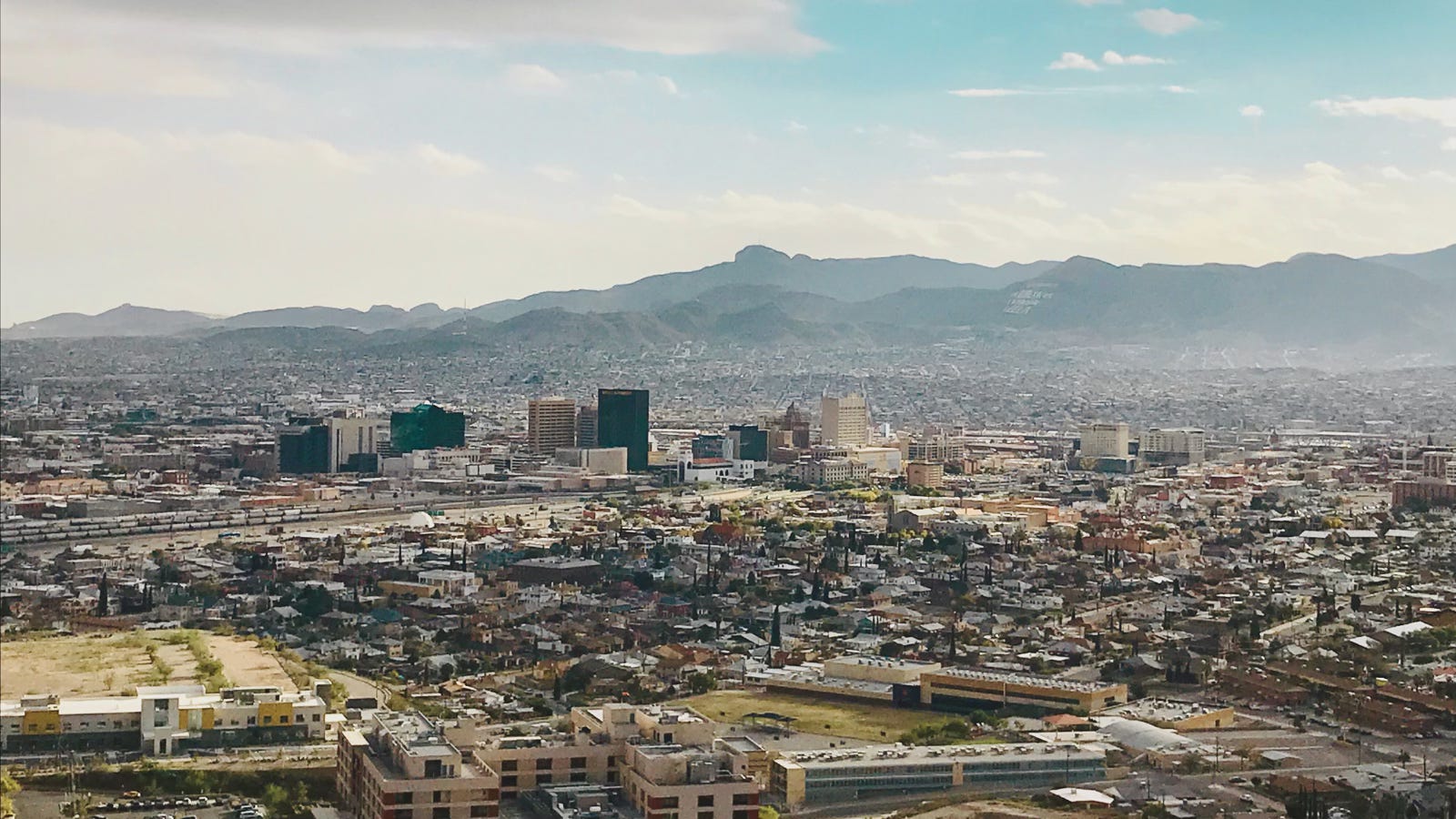
This week, the Federal Aviation Administration (FAA) abruptly classified the airspace over El Paso as "National Defense Airspace." Flights were grounded. Pilots were told the shutdown would last 10 days. Hospitals scrambled. Travelers were stranded. Local officials were blindsided.
And then, within hours, it was lifted.
El Paso is my hometown. I grew up there. I still have family and friends there. So when I saw the notice citing “special security reasons” and grounding aircraft up to 18,000 feet, I didn’t see a bureaucratic hiccup. I saw a warning sign.
Publicly, Transportation Secretary Sean Duffy claimed the closure was triggered by a cartel drone incursion that had been “neutralized.”

But multiple reports tell a more complicated story.
According to CNN and several other media outlets, the Department of Homeland Security’s Customs and Border Protection (CBP) personnel were operating a high-energy counter-drone laser system on loan from the Department of Defense, before the FAA had completed its safety review of the technology’s impact on civilian aircraft. Officials reportedly believed they were targeting a cartel drone. It turned out to be a party balloon.
Yes, you read that correctly.
The FAA then issued a sweeping Temporary Flight Restriction, classifying the area under national defense authority after powerful technology was deployed without full aviation clearance.
That designation is not symbolic. It carries serious enforcement implications, including interception authority and the potential use of force. Airspace does not close over a major American city for optics. It closes because something inside the federal system broke down. We have recent, tragic proof of what happens when that breakdown involves military and civilian aviation systems.
Just last year, a mid-air collision over Washington, D.C., between an Army Blackhawk helicopter and an American Airlines regional jet killed 67 people. The National Transportation Safety Board (NTSB) concluded that systemic failures across agencies—including the Army and the FAA—contributed to the crash. Known risks had gone unaddressed for years.
Sixty-seven people died because weak signals weren’t acted on. Among them were the parents of Olympic figure skater Maxim Naumov. He is now competing on the world stage without them—carrying their photo, honoring them in every glide across the ice. This is the human cost of institutional failure.
That crash was 100% preventable, according to the NTSB.
Aviation safety depends on precision, communication, and discipline—not improvisation. When powerful counter-drone technology is accelerated near civilian airspace without full clearance, the public is right to ask hard questions.
The Disconnect Is the Story
This is not just about a mylar balloon. It is about coordination, or the lack of it.
Let’s review the facts:
The counter-drone laser deployment accelerated before full FAA coordination was achieved.
The FAA shut down the airspace without notifying the White House or the Pentagon in advance.
Local officials in El Paso were not warned before the restriction went live.
Members of Congress are demanding briefings after conflicting federal explanations emerged.
The Mayor of El Paso, Renard Johnson, said on CNN this morning that, as of today, federal officials still had not contacted his office with a clear explanation for the shutdown. El Paso is the sixth-largest city in Texas and the 22nd-largest city in the United States. Nearly 700,000 people live there. This is not a minor jurisdiction that can simply be left in the dark. This is a major American city with hospitals, military installations, cross-border commerce, and an airport that serves roughly 100 flights a day.
You do not ground a city like that without airtight coordination, especially along one of the most sensitive international borders in the world.
When Language Escalates, Power Follows
Drone incursions along the border are not new. Military officials have testified that they occur frequently, sometimes more than 1,000 per month. I worked on homeland security and border policy in the Office of the Vice President of the United States. I am well aware that such incidents occur. But the way these events are framed matters. In the case of El Paso, federal officials described a cartel drone breach and declared the “threat neutralized,” language that conveyed urgency and severity.
As a reminder, there has been no confirmed cartel drone strike on U.S. soil. Experts like myself make a clear distinction between incursions into airspace and attacks on people or infrastructure.
What made El Paso unusual was not the object in the sky, it was the scale of the response. That distinction matters. When rhetoric outpaces risk, authority expands to match it.
Congresswoman Veronica Escobar, whose district includes El Paso, made this point explicitly in a press conference: "There have been drone incursions from Mexico going back to as long as drones existed. This is not unusual, and there was nothing extraordinary about any drone incursion into the U.S. that I’m aware of."
Her criticism underscores how unusual the government’s framing was, especially when the FAA rarely closes airports entirely–even in high-risk situations. For example, when the U.S. military captured Venezuela’s leader Nicolás Maduro in January, the FAA issued flight restrictions for just 24 hours, a fraction of what was initially announced for El Paso. If an incursion is framed as an attack, the menu of "justified" responses expands. And in the current political environment, that expansion is not theoretical.
And I have seen how that shift happens.
During the first Trump administration, I sat in discussions where cross-border military action against cartels was openly debated. The idea of striking inside Mexico was not theoretical. It was raised. It was entertained. It was discussed in the context of deterrence and political optics. That rhetoric did not disappear. Over the past year, there has been renewed consideration of drone strikes on cartel networks, expanded surveillance flights over Mexico, and repeated public statements that "all options are on the table."
So when a major American city is abruptly placed under national defense restrictions, powerful counter-drone systems are accelerated near civilian airspace, and the public explanation shifts in real time…
You pay attention.
The Border Is Not a Testing Ground
El Paso is not a laboratory for political theater. It is not a headline prop. It is a living, breathing American community.
When sweeping federal authority is invoked and then reversed within hours…when local leaders are left scrambling on live television…when explanations change faster than the facts…That is not strength. It is instability. And instability in national security decision-making is dangerous.
Even if this episode ultimately proves to be bureaucratic overreach rather than deliberate escalation, it revealed something deeply concerning:
Power is moving faster than the guardrails designed to contain it.
National defense authority is serious. It is not messaging or optics. And it is not something to invoke casually and retract quietly.
Transparency is what separates national security from political theater.
When the sky closes over your hometown, you don’t shrug.
You ask:
Who authorized it? Why did Secretary of Defense Pete Hegseth give DHS/CBP the authority to use the system ahead of the FAA’s safety review? Who coordinated it? Why did the story shift? Why was a major American city left in the dark?
El Paso deserves clear answers. So does the rest of the country.
Independent national security analysis matters right now. I’ve been inside these rooms. I know how quickly rhetoric turns into policy, and how policy can turn into escalation. Paid subscribers make this work possible and help keep it independent, fact-based, and unfiltered by partisan interests. If you value clarity in moments like this, please continue to support it.
More soon,
Olivia
Thank you for bringing some clarity to this strange and, frankly, scary situation. My thoughts quickly went to a potential military action against Mexico. I put nothing past this regime.
The general consensus in the aviation community is that the way the ELP closure was handled shows that no one in authority knows what they're doing. It has rattled a lot of people's confidence in the National Aerospace System. Many are not buying the "cartel drone" bullshit. I detect the drunken hand of Whiskey Pete in this.