


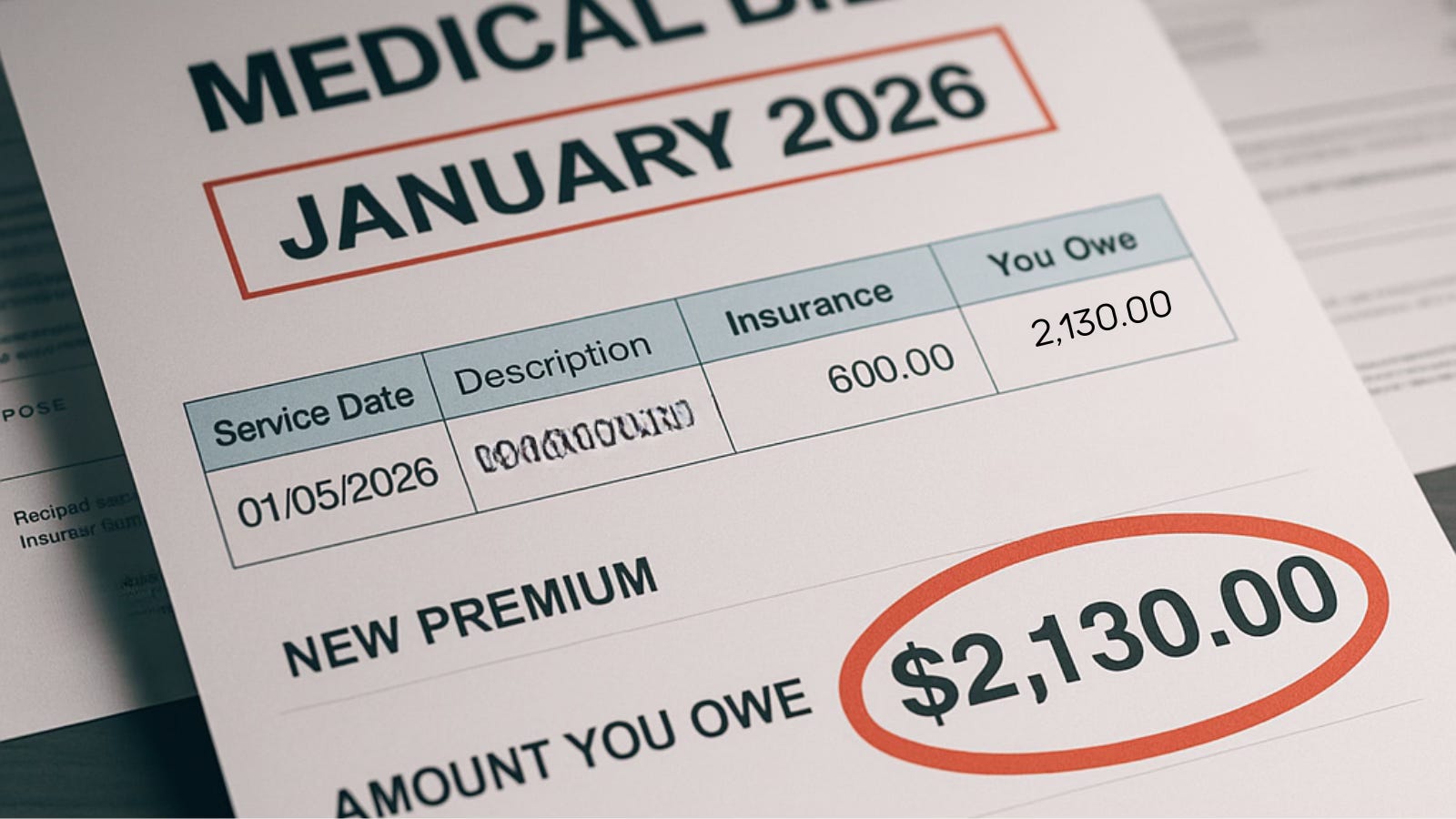
Something big is about to hit American families on January 1, and almost no one sees the full picture. As a predominantly national security expert, why do I care so much about this? Because I’ve spent my career connecting the dots to keep America safe, and this is one of those dots.
While headlines focus on affordability struggles and economic anxiety, the real crisis is happening in the shadows: health-care costs are about to surge across every system at once. Affordable Care Act (ACA) premiums are jumping by double digits, millions pushed off Medicaid remain without options, and employer plans face their biggest cost increase in more than a decade. Meanwhile, Speaker Mike Johnson is pushing to strip IVF coverage from military families.
This is why people feel like they’re living in a recession: America keeps shifting more and more of the burden onto families already stretched to the breaking point.
This is the squeeze. And January is when it becomes visible.
Combined, this isn’t just health policy, but a slow-motion, government-engineered pay cut for working families, reflected in your January bill. Much of this squeeze was baked into the health-care package Republicans passed earlier this year. The one Trump branded his "big beautiful bill," even as it raised costs and weakened protections for millions of families.
What’s actually happening in the numbers
ACA Marketplaces
Insurers are increasing ACA Marketplace rates by an average of 26% for 2026. In states using HealthCare.gov, the benchmark silver premium is rising around 30%. In state-run marketplaces, premiums rise about 17%. Most people haven’t felt these hikes yet because enhanced premium tax credits expire Dec. 31, 2025. Without those enhanced subsidies, what people actually pay more than doubles. KFF, an independent source for health policy research, polling, and news, estimates average net premiums jump 114%, from $888 to $1,904 a year! Trump-era rule changes have also led to higher required contributions from families if enhancements lapse, further increasing household costs.
Medicaid Losses
During the pandemic, states paused most Medicaid disenrollments. That ended in 2023. Since the "unwinding," at least 25 million people have lost Medicaid coverage, about 31% of completed renewals. KFF’s national analysis shows about two-thirds of disenrollments have been procedural: paperwork, bad addresses, confusing forms–not ineligibility.
I warned last summer that Medicaid would be hit with a thousand cuts–legislative, administrative, and ideological. Now it’s here. Millions have lost coverage not because they did anything wrong, but because the system was quietly designed to make them fall through the cracks.
Employer Insurance
The average family premium rose to $26,993 in 2025, up 6% from the year before.
Workers now pay an average of $6,850 out of pocket.
Employers project 2026 health benefit costs will rise 6.5%, and nearly 9% without aggressive cost containment, the largest increase in 15 years.
These are different systems, but they’re all tightening at once, hitting the same families from different angles.
This is where "silent recession" becomes daily life:
A parent opens their ACA renewal and finds they owe an extra $80–$150/month.
A worker sees their “raise” erased by a higher premium and deductible.
A family kicked off Medicaid only discovers it once someone gets sick.
Meanwhile, medical debt is exploding:
20 million adults in the U.S. carry significant medical debt (>$250), totaling at least $220 billion.
36% of households report having some form of medical debt (Read the stats on the NIH website while you still can, before this administration buries the data.)
30 million Americans borrowed money for medical care in 2024, adding $74 billion in loans and credit card balances.
When premiums and deductibles rise while subsidies vanish, predictable consequences follow:
Prescriptions skipped
Visits delayed
Debt accumulated
Systems blamed for "individual choices"
It’s evidence of a broken structure where families are saddled with rising costs they can’t absorb, while the health-care system shifts the burden away from those with the most power.
What You Can Do Before Jan. 1
Check your ACA renewal, don’t let it auto-roll. Auto-renewal can lock you into a plan whose net premium doubles.
Compare the benchmark silver plan to your current plan.
Recalculate your subsidy: https://www.healthcare.gov/see-plans
Lost Medicaid? You likely qualify for a Special Enrollment Period (SEP). You get 60 days from the loss of Medicaid to pick an ACA plan. Many states have extended SEPs due to unwinding chaos.
Ask your employer these 3 questions right now:
How much is my total premium increasing?
Are deductibles/copays rising?
Is there a lower-cost plan with the same network?
Check state-level affordability programs. Some states provide state-funded subsidies, basic health programs, or medical debt relief.
Verify your income is accurate. Incorrect income is the #1 cause of subsidy loss and tax credit clawbacks.
Small steps now prevent painful surprises later.
And the squeeze doesn’t stop there. The same administration raising costs across the system is now moving to take IVF away from military families.
The IVF cut House Speaker Mike Johnson doesn’t want you to notice
While families brace for higher health-care costs in January, Speaker Mike Johnson is quietly trying to remove one of the few protections military families were finally about to gain.
Behind closed doors, Johnson is working to strip IVF coverage from the NDAA—a provision that would have required TRICARE to cover assisted reproductive technologies for all active-duty service members.
TRICARE only covers IVF when infertility is caused by a “serious or severe illness or injury” on active duty. That leaves out:
Medical infertility not tied to deployment
Unmarried service members
LGBTQ+ service members requiring donor material
Couples whose infertility doesn’t meet a narrow injury-based definition
In other words: most of the force.
U.S. Sen. Tammy Duckworth (D-IL) has warned that Johnson’s maneuver would “single-handedly” kill bipartisan progress. Members of Congress already receive IVF coverage; military families do not.
The reality for military families
15.8% of women veterans report infertility
13.8% of men do
40% of affected veterans sought treatment
Infertility in military families is estimated at four times the civilian rate
IVF costs $12,000–$20,000 per cycle, out of reach for junior enlisted families earning $30,000–$45,000/year.
Johnson’s action would keep it that way.
The political contradiction
This rollback contradicts Trump’s public promise to expand IVF access, including his October announcement promoting a White House deal to lower fertility treatment costs.
And here’s what’s important: in 2024, I warned this was coming.
I was well familiar with the Project 2025 playbook and with the people behind it. Russ Vought and others in that circle have been explicit for years that IVF and embryo status would be targets of a “post-Roe” agenda. While Trump said many things publicly to reassure people during the election, those of us who lived inside that ecosystem know the truth: the real agenda shows up in the quiet policy moves, not the loud campaign promises. And it was never limited to reproductive rights. I warned then that Medicaid and health care would be targeted as well. We are now watching that agenda unfold in small but telling increments. Do not lose sight of this.
In a year when American families are drowning in medical costs, Speaker Mike Johnson found time for one thing: attacking IVF care for the military families who need it most.
Health care is where America’s reality shows up first. Not as an abstract policy debate, but as a bill, a skipped prescription, a denied claim. The premium spikes, Medicaid losses, employer increases, IVF rollback—they’re all part of a larger story: who this country is protecting, and who it isn’t.
January will expose a truth many families already know: the system isn’t working for them, and it didn’t break on its own. The question now is whether our leaders will fix it or keep pretending families can carry the weight alone.
And for the Republican Party, a party I once believed would fight for the military and the working class, this moment is something deeper than a policy failure. It’s a brutal betrayal of Americans they have chosen to forget.
I haven’t forgotten them. I never will.
Until next time,
Olivia
Make Republicans own 100% of these price increases.
Is there a rationale to the GOP measures? To me it looks like they want to keep us poor, sick and uneducated.