


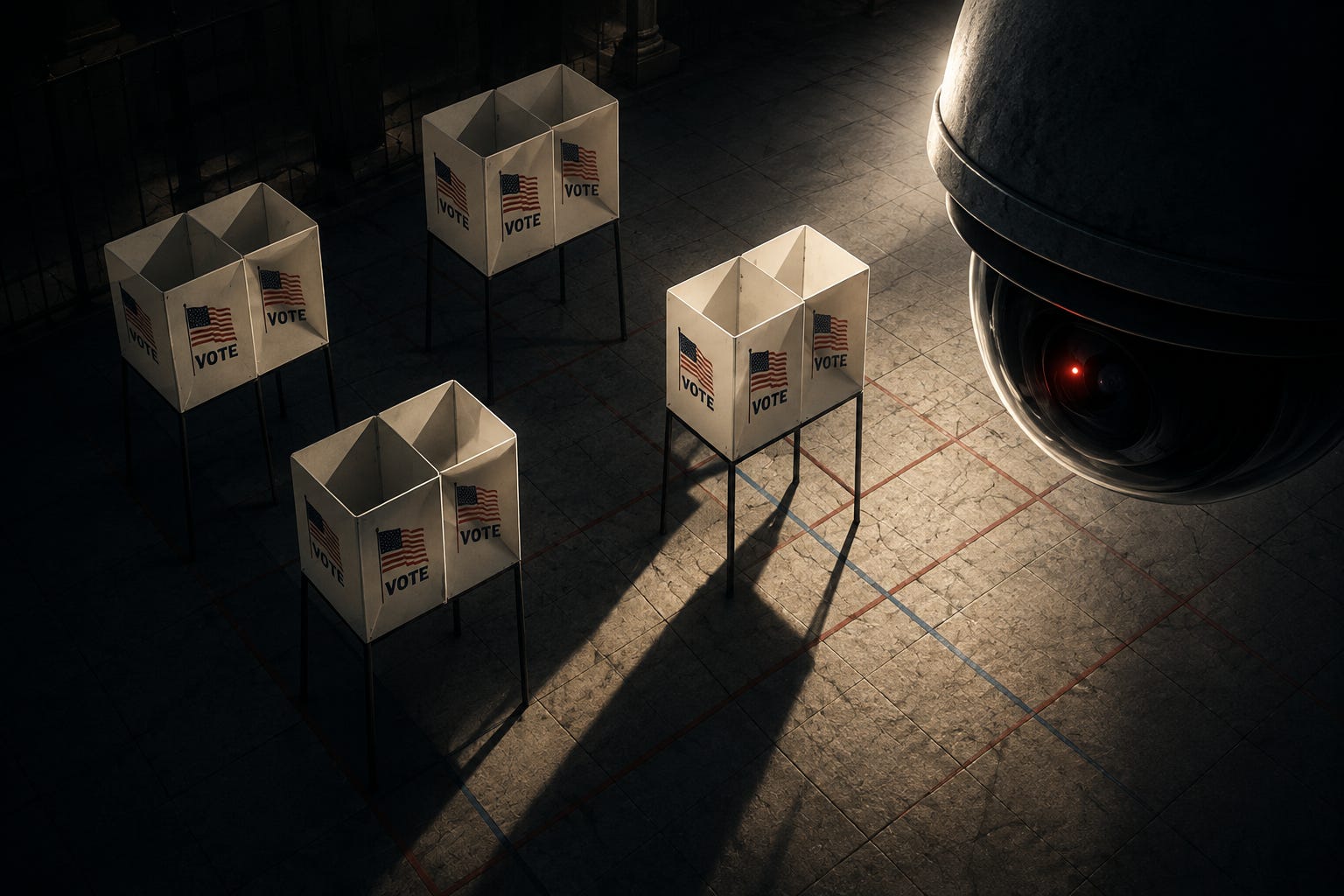
Federal agents are launching a voter-fraud surge across nine states, starting today, that will continue as Americans begin casting ballots in the midterm elections. I spent years inside the Department of Homeland Security and counterterrorism communities. The dates caught my attention, but the agency they chose got my full attention. According to internal federal guidance obtained by CNN, Homeland Security Investigations (HSI) is kicking off a "coordinated criminal voter fraud surge initiative." Field interviews, investigative leads, and potential prosecutions will take place from now through mid-October.
If this is your first introduction to HSI, don’t feel bad. ICE eats all the headlines, and FEMA soaks up whatever’s left, but I know this agency. HSI is not the Department of Motor Vehicles (DMV) with badges. It’s ICE’s principal investigative arm, built to go after things like terrorism financing, human trafficking, cyber intrusions, weapons smuggling, and the money behind cartels. Its agents sit on Joint Terrorism Task Forces with the FBI. This is serious machinery, built for serious threats. Which is exactly why it’s strange to watch it get pointed at your county’s voter rolls.
Prefer to watch? Watch my full video breakdown below.
This isn’t the first stretch, either. HSI’s mission has already been bent during this Presidential term. ICE has two lanes: Enforcement and Removal Operations (ERO) handles immigration arrests and deportations, HSI handles criminal investigations. Almost immediately after Trump returned to office, Border czar Tom Homan folded HSI into a “whole of government” immigration surge alongside ERO, the FBI, DEA, ATF and the Marshals. It has been all hands on deck for arrest numbers. Specialized investigators trained for terrorism, cybercrime and transnational crime got reassigned to immigration enforcement. Now they’re being redeployed again. This time toward American voters in Washington, Wisconsin, Missouri, Georgia, California, Pennsylvania, Nevada, New York and Connecticut (Anyone else notice some critical election swing states in there?)
To be clear, if someone knowingly votes while ineligible, that’s a crime, and crimes should be investigated. I’m not arguing otherwise. The question is narrower and much less comfortable: why does an agency built for cartels and terror cells suddenly have the bandwidth, and the mandate, to go door-knocking on election integrity, three months out from a national election? And does the evidence actually justify the size of the response? In national security, you don’t start with the response you want and reverse-engineer a threat to justify it. You start with the threat. What is it, how big is it, what does the evidence actually show, and what response is proportionate? I spent years in rooms where that sequence determined which agencies got involved and where resources went. So let’s run the numbers HSI is supposedly acting on.
The 250,000 number that isn’t
This summer, the White House and DHS announced it had found more than 250,000 registered noncitizens across California, Pennsylvania, New Jersey and Nevada. That’s a big, scary, headline-ready number. Then you look at Nevada, one of the four states in that count. DHS told Nevada it had found nearly 16,000 noncitizens on the voter rolls. Somewhat alarming, until DHS clarified that 16,000 was just a raw list that still needed to be manually checked, person by person.
So how many did DHS say it was actually confident about?
185.
Another 6,200 were "higher confidence, needs more vetting." Over 14,000 needed further review before anyone could say anything about them. Nevada asked DHS for the underlying data to verify even the 185. DHS said no.
Nevada’s deputy secretary of state for elections put it plainly: "We are unable to conduct an analysis without real verifiable information."
Maybe some of those 185 turn out to be real. Investigate them. That’s the whole point. Investigate what you can substantiate; don’t build the scary number first and go looking for the crime after. That’s not how you run a national security operation, and it’s certainly not how you should run an operation aimed at American voters.
A database match is not a conviction
HSI’s real strength is connecting data across systems, which is useful when you’re tracking a cartel’s money. It’s considerably less reassuring when the dataset is your neighbors. Names overlap. Addresses go stale. Records lag. A match doesn’t mean you found a crime; sometimes it doesn’t even mean you found the right person.
Nevada officials said the quiet part out loud: they were worried about accusing an actual U.S. citizen of being a noncitizen and leaving them scared, harassed, or unable to vote. That’s not a clerical error, it’s a person’s ballot. Keep that in mind, because the disinformation machine around the midterms is already running hot, and a headline number is a lot easier to spread than a correction.
If this kind of analysis is useful to you, subscribe to Olivia of Troye. There’s a lot happening right now, and a lot more I want to dig into with you.
And DHS wants to take this national
Last week I flagged that ICE is exploring hiring a private contractor to collect voter-registration and voting-history files nationwide, all 50 states, D.C., the territories, feeding it to HSI for "fraud detection and data segmentation." Right now it’s only a request for information, not an awarded contract, and the draft says jurisdictions shouldn’t be picked based on politics. Sure…
However, the architecture on the table is a standing, recurring pipeline of voter data ➡ flowing into federal law enforcement ➡ potentially routed through a private contractor ➡ then treated as DHS’s own acquisition agent.
Now put the pieces on the table together: HSI agents already stretched thin on immigration enforcement, redeployed onto a voter-fraud surge, built on numbers that dissolve under scrutiny, layered on top of a proposal to vacuum up voter data nationwide, all landing in the same eight-week window before Americans vote.
Each piece has an explanation if you squint. Stacked together, that’s not a coincidence, that’s a pattern.
Protecting elections is not the same as policing them
DHS absolutely belongs in election security: foreign hacking, physical threats to election workers, infrastructure attacks. That’s real, and it’s necessary; however, protecting the system is different from investigating the people inside it.
American elections are deliberately decentralized; your county clerk runs your polling place, not the federal government. The Department of Justice’s (DOJ) own guidance warns that overt investigations near an election can chill legitimate voting and drag the investigation itself into the political fight. DHS isn’t bound by that DOJ policy, and this new guidance doesn’t even mention the concern.
Sit with that.
Then there’s the military
This week, Chairman of the Joint Chiefs General Dan Caine had to put something remarkable in writing, in an official letter to a sitting senator: the military has no plans to send federal troops or federalized National Guard members to polling places, and no plans to seize ballots or voting machines.
Good. That’s exactly the answer we should want. But I can’t shake the fact that in 2026, in the United States of America, someone had to ask. And I’ll say this plainly: I have been deeply concerned about Trump deploying troops as we get closer to the midterms. I still am.
Caine’s letter doesn’t erase that concern. Because troops don’t have to be stationed at polling places to affect what’s happening around an election. Having served in the White House during Trump 1.0, I know what the President does when he lashes out. As Trump grows increasingly angry about the possibility of Republicans losing Congress—and the investigations, subpoenas and accountability hearings that could come with it—I’m watching what happens in American cities very closely.
The justification for deploying forces doesn’t have to be the election. It can be immigration. An “invasion.” Crime. Riots. Disorder. Protecting federal personnel or property. Pick your emergency.
We’ve already watched this administration deploy federal forces into American cities over the objections of state and local leaders. In 2024 I publicly warned that this would happen should he return to office, and it did. That’s why I’m not only watching whether troops appear at polling places. I’m watching whether they’re deployed to the streets around them in the weeks leading up to Election Day.
Trump often says the quiet part out loud. Stephen Miller’s role has been different: turning the president’s impulses into executable policy that also benefits his conniving agenda.
So no, I don’t expect anyone to stand at a podium and announce, We’re deploying troops because of the election. I’m watching what they do, and what justification they use to do it because you don’t have to put a soldier inside a polling place to change the atmosphere outside of one.
Tonight, in one of those nine states, a local election official—Republican, Democrat, or neither—it doesn’t matter, is testing equipment and answering angry emails, bracing for the next round of harassment over a job most people don’t even know exists. Before you share the next viral fraud claim about them, ask the questions I learned to ask for a living: What’s the threat? What’s the evidence? Does the response actually match it?
And let me be clear about something else: none of this should scare anyone away from participating. Stay vigilant. Ask questions. Pay attention. But no matter what happens between now and Election Day, get out and vote.
Our elections don’t belong to ICE, DHS, the military, or any president.
They belong to us.
The deep dives are back. I’ve got a lot more coming your way, and as I think about where we go from here, I want your input. Please take this quick survey and tell me what you think.
Until next time,
Olivia
Thank you, Olivia! This is a great, understandable analysis of the situation at-hand. It's intimidating to a point, but also persuasive in that we must show up and exercise our right to vote. Much appreciated.
I so much appreciate you, Olivia. You always are clear about what is happening, and I learn from you, knowing you've been there. Please keep doing what you do.