


This week ended with a reminder: the First Amendment only works if we use it.
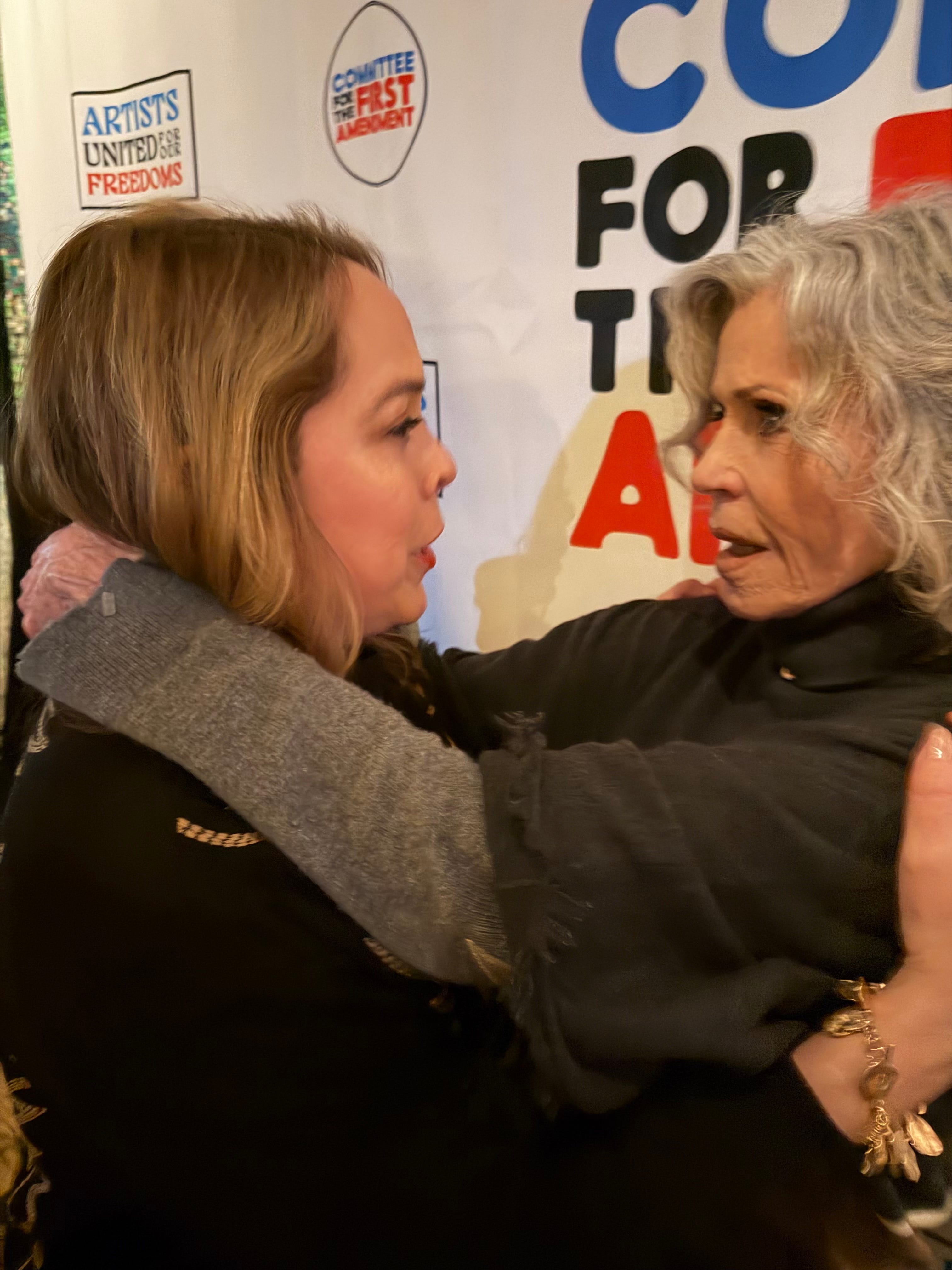
Yesterday, I stood with Jane Fonda and others calling on people to take a stand, defend the First Amendment, and break the silence. It’s hard to put into words what it felt like to finally meet someone who didn’t just speak out—but helped define what that looks like in real time. She didn’t wait for permission. She stood firm when it mattered. She inspired women like me to take a stand—to break the silence, and use our voice when it matters, even when it’s hard.
That kind of courage doesn’t just leave a mark. It creates momentum.
No kings. No fear. No backing down.
Here are five things that matter from this week.
1. Americans Say We’ve Lost Basic Decency, And They’re Right
This isn’t just polarization. It’s something deeper.
A new “Dignity Barometer” survey shows nearly 8 in 10 Americans say they treat others with dignity, even when they disagree. But less than half feel they receive it back. That gap has a name: the dignity gap.
94% of Americans believe people deserve dignity. Only 31% think we actually live it.
That’s not abstract. That’s what people feel every day.
We’ve built a culture where contempt is rewarded, amplified, and weaponized, leaving people exhausted. Many now believe the division is so deep that we may not even be able to solve our biggest problems. And yet, the answer isn’t a mystery.
Americans overwhelmingly agree: dignity builds trust. It bridges divides. It’s the only way forward, even across disagreement.
As Timothy Shriver, chair of Special Olympics International and co-creator of the Dignity Index, put it: the problem isn’t that we lack values. It’s that contempt that is crowding them out. And once contempt takes over, conversations shut down.
That’s where we are. We say we believe in dignity. We just don’t practice it. And that disconnect is now big enough that Americans are calling it a crisis. Because this isn’t about being nicer. It’s about whether we can still function as a country.
🤝 America’s “Dignity Gap” Is the Warning Sign: The Dignity Index
2. The System Isn’t Just Cruel, It’s Breaking the People Running It
This is what it looks like when a system is pushed past its limits. The acting head of ICE, Todd Lyons, has reportedly been hospitalized multiple times from stress while trying to carry out this agenda. Let that sink in.

I’ve been on those calls with Stephen Miller on the other end. Angry. Loud. Relentless. Designed to pressure.
In my case, it wasn’t about ICE or numbers. I didn’t work that mission. We argued over things like his push to bomb Mexico, expand Title 42, slash refugee admissions, and impose the travel ban—the most extreme homeland policies he wanted to force through. And I fought him. Often. Alongside others who knew better. I’m not there to fight him today inside the system, but I can say this clearly: he is the same deplorable person he was then. The difference now? He has more power and fewer guardrails.
That same pressure is now being directed at the people running immigration enforcement—quotas, targets, demands that don’t match reality. And people are getting hurt. We’ve already seen it: fatal encounters, aggressive tactics, lives lost on the ground. This isn’t pressure in service of policy. It’s pressure that’s costing lives.
When an agency is pushed to operate like this, where outcomes matter more than judgment, overriding humanity, it’s not just failing. It’s operating exactly as designed. That means the answer isn’t tweaks around the edges. It means ICE as an agency needs to be fundamentally dismantled, its mission rebuilt, and its purpose redefined before more damage is done.
🤦 Even the People Enforcing It Are Cracking: Politico
3. They Call It Meritocracy, It’s Actually White Christian Nationalism
I’m still not over this, and you shouldn’t be either.
Defense Secretary Pete Hegseth personally removed four Army officers from a promotion list, an extraordinary move now raising legal questions. Two of those officers are Black. Two are women. The Army Secretary refused to remove them, citing decades of exemplary service. Hegseth overrode him anyway. That’s not how this is supposed to work. Military promotions at this level are meant to be insulated from politics to protect merit, not manipulate it.
But that guardrail is breaking.
According to reporting, a senior aide argued that Donald Trump wouldn’t want to appear publicly alongside a Black female officer. Read that again.
These officers being disparaged are combat-tested leaders. They earned their place. And now they’ve essentially been erased. Hegseth framed it as “meritocracy.” Let’s call it what it really is.

Because this doesn’t exist in a vacuum.
Hegseth has elevated figures like pastor Doug Wilson, who has argued women shouldn’t vote and defended slavery on “scriptural” grounds, even inviting him to preach at the Pentagon. And voices in that same orbit are going even further. On one podcast, a host said he prayed that James Talarico, currently running for U.S. Senate in Texas, be stopped “by any means necessary”, even saying, “I pray that God kills him,” as Brooks Potteiger nodded along.
That’s not fringe. That’s proximity to power. And it tells you everything about the dangerous environment being created.
Who gets elevated. Who gets removed. What gets normalized. That’s the pattern.
Filter leadership through politics or ideology, and the system doesn’t just weaken; it hollows out. And that shows up in readiness. In morale. In trust.
These officers gave decades to this country, and in a moment, they were told it wasn’t enough. They deserve better. Yes, I’m angry. We all should be.
🎖️ This Isn’t Meritocracy, It’s a Pattern: NY Times
4. In the Middle of War, Ukrainians Built Shelter
Not everything this week was about power or politics. Some of it was about people choosing to care.
In war-torn areas near Kharkiv, volunteers partnered with animal welfare groups to build and deliver 100 insulated doghouses for stray and abandoned dogs trying to survive the cold. It’s a small thing, on paper. But nothing about this is small. These animals are living through the same war. Bombings, displacement, and constant stress. Many were left behind. Others pulled from front-line areas. All of them are trying to survive conditions most of us can’t imagine.
So people showed up. They built shelters by hand. They delivered them into active conflict zones. They made sure these animals had warmth, protection, and even a small sense of safety. The world can feel like it’s hardening. But then you see something like this, and you’re reminded it hasn’t all the way.
🐾 They Built Shelter for Dogs in a War: People
5. The System Didn’t Just Fail. It Processed It.
This one is hard to read. But it matters.
A new lawsuit alleges a woman trafficked by Jeffrey Epstein was directed to open a bank account used for years to move money tied to her abuse.
According to the filing, she was exploited at least 100 times over nearly a decade. And during that time, financial systems didn’t just miss it; they were used to facilitate it, with funds flowing through major institutions like Deutsche Bank.
This isn’t isolated.
JPMorgan Chase and Deutsche Bank have already paid hundreds of millions in related cases. Now, Bank of America is paying $72.5 million.
So the question is: how many warning signs does it take before a system built to catch financial crime actually stops it? Because this wasn’t hidden. It was structured. Repeated. Sustained. That’s not just a failure of oversight. It’s a failure of will.
We like to think systems protect people. But too often, they protect themselves. And when they do, harm isn’t a failure. It’s by design.
⚖️ The System Saw It. And Kept Going: WSJ
🤍 ONE THING FOR YOUR SOUL
Sometimes the most meaningful thing we do is show up for someone we barely know.
There’s a story by Nathan Rousseau Smith about a man who rushed to help his neighbor during a medical emergency. He performed CPR, staying with the family, holding space in their worst moment, but he couldn’t save him. Afterward, he kept asking himself: Did I do enough?
Here’s the truth he comes to understand, and one we all need to hear: You don’t have to be perfect to matter. You don’t have to save someone to show up. Sometimes, the most important thing you can do is simply not walk away.
He thought he was "just the neighbor." He wasn’t. None of us are.
So, as we head into No Kings Day, check in on someone. Knock on the door. Say the thing. Be the person who shows up.
It will matter more than you think.
🏠 I Tried to Save My Neighbor: Huffington Post
See you out there at No Kings! If you can’t make it, I hope you’ll catch the live stream with Don Lemon, Jim Acosta and Joy Reid!
And, thank you all for standing with me throughout Richard Grenell’s lawsuit against me. They tried to intimidate. I didn’t back down, and we won.
More soon,
Olivia
That picture of you and Jane - capturing brave women in action.
After Hegshit latest move of removing 2 black officers and two women officers with no push back by republicans , I think it smells, looks,and walks like a duck. We can now officially call the republican party what it really is the republican-communist-fascist party. As a retired military I am ashamed of what Hegshit is doing to honorable and outstanding members of our armed forces.