


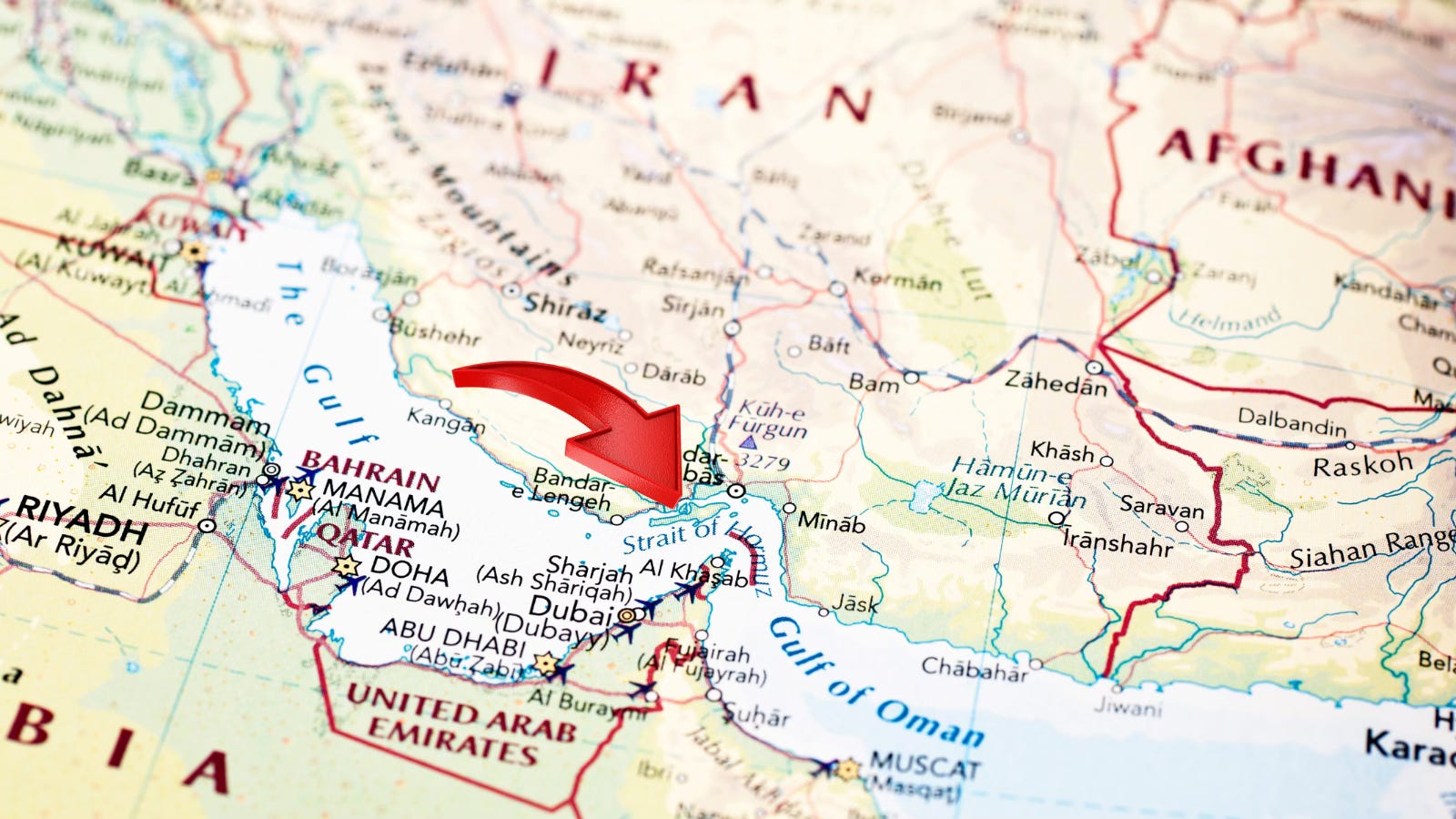
There’s a stretch of water so narrow you could nearly shout across it. Twenty-one miles at its tightest point. Two shipping lanes, each barely two miles wide, threaded between Iran to the north and Oman to the south.
It has no rival. No bypass. No adequate replacement. And when it stops transport, the world feels it.
Right now, it is effectively paralyzed. Normally, about 100 oil tankers pass through the Strait of Hormuz every day, carrying roughly one-fifth of the world’s oil. Today, that traffic has nearly vanished.
Ships have turned around. Insurers are withdrawing coverage. Over 150 vessels now sit stranded in or near the Gulf waiting for safe passage.
The Strait of Hormuz is not just a geography lesson.
It is the jugular vein of the global economy.
Attacks on Ships, Mines in the Water
This is not a hypothetical threat.
In recent days, multiple commercial vessels have been struck by projectiles in or near the Strait. A Thai bulk carrier, a Japanese container ship, and a Marshall Islands-flagged cargo vessel were damaged in separate incidents. One strike caused a fire onboard and forced most of the crew to evacuate. Several sailors remain missing.
Iran has also begun deploying naval mines in the Strait—one of the most dangerous escalations possible in maritime warfare. U.S. military officials say they have already destroyed sixteen Iranian mine-laying vessels. Even the suspicion of mines can halt shipping, and clearing them can take weeks.
U.S. Central Command says its operations are focused on destroying Iranian missiles and drones while degrading Tehran’s ability to disrupt traffic through the Strait. But in a chokepoint like Hormuz, Iran doesn’t need to sink every ship. It only needs to convince insurers and captains that the next one might be theirs.
Once insurance disappears, the system stops. Ships cannot enter ports. Banks will not finance the cargo. Trade freezes long before any formal blockade is declared.
The Energy Shock
Yes, the immediate effect is energy volatility.
Oil prices surged above $110 per barrel earlier this week before settling closer to the mid-$80 range as markets reacted to hopes of de-escalation. Even so, prices remain well above where they stood before the conflict began. American consumers are already feeling the pressure. The national average for gasoline has climbed to about $3.58 per gallon, according to the American Automobile Association (AAA).
And the shock is already rippling through global markets. The International Energy Agency is considering what could become its largest coordinated release of emergency oil reserves, while France has called an emergency meeting of G7 leaders to address the crisis.
Energy touches everything. Fuel powers transportation. Transportation moves food. Food prices drive inflation.
The Other Country Benefiting From This Crisis
While Washington focuses on Iran, another geopolitical actor is quietly benefiting from the disruption: Russia.
Higher oil prices strengthen Moscow’s war economy. Russia remains one of the world’s largest energy exporters, and every spike in global crude prices generates revenue that helps finance its war in Ukraine. European leaders have warned that the Middle East conflict is already providing Russia with new resources while diverting Western attention and military capacity away from the Ukrainian front.
U.S. intelligence officials have also warned that Russia may be sharing targeting information with Iran that could help Tehran strike U.S. personnel and assets in the region. President Donald Trump dismissed the concern, saying if Russia is sharing such intelligence, "it’s not helping them much." He has continued to call Russian President Vladimir Putin a possible diplomatic partner, saying after a recent call that Putin "wants to be helpful."
Let’s not forget: the relationship between Moscow and Tehran has deepened significantly since Russia’s invasion of Ukraine. Iran has supplied Russia with thousands of attack drones used against Ukrainian cities, and the two countries signed a strategic partnership agreement in 2025 expanding military cooperation.
Now we’re supposed to believe that one of America’s most persistent adversaries suddenly wants to be helpful.
Sure.
And I’ve got some oceanfront property in Arizona to sell you.
The Story Most People Are Missing: Fertilizer
Energy is the headline story. But it’s not the only one.
The Persian Gulf is also one of the world’s largest producers of nitrogen fertilizer. Fertilizers like ammonia and urea are made using natural gas as their primary ingredient. Because Gulf countries have access to some of the world’s cheapest natural gas, places like Qatar and Saudi Arabia built massive fertilizer industries around it. Much of that fertilizer is shipped through the Strait of Hormuz.
Why does that matter?
It matters because modern agriculture runs on nitrogen fertilizer. Roughly half of global food production depends on it. And much of that supply runs through Hormuz.
If fertilizer shipments are disrupted as planting season begins, farmers will feel it first. The consequences appear months later—in smaller harvests, tighter grain supplies, and rising food prices.
In my home state of Virginia, the stakes are not abstract. Across the Commonwealth, nearly 39,000 farms grow crops like corn, soybeans, and wheat—crops that depend heavily on nitrogen fertilizer. With roughly 40–50% of globally traded nitrogen fertilizer originating from Gulf producers and moving through the Strait of Hormuz, disruptions there could ripple directly into higher input costs and tighter supplies for farmers here at home. Farmers like Virginia grower Heath Cutrell are already bracing for the impact.

For many countries, this is not just about higher grocery bills. Across parts of Africa and South Asia, food systems already operate on razor-thin margins. A disruption that tightens global grain supplies can push millions closer to hunger almost overnight. When prices spike, wealthier countries absorb the shock. The poorest countries cannot. That is when food crises, and sometimes famine, begin to emerge.
This chain reaction is exactly what security planners have warned about for decades. Military planners have long recognized the danger posed by a threat to the Strait of Hormuz. It is one of the most dangerous strategic chokepoints in the world, not just because of its geography, but because so many global systems depend on it at once.
A single waterway now sits at the center of forces that can shake energy markets, strain American farmers already dealing with tariff damage to agricultural exports, strengthen Russia’s war economy, and threaten the global food supply. And when those forces begin to move, Americans eventually feel it too, at the gas pump and at the grocery store.
The bombs make the news.
The fertilizer does not.
But fertilizer shortages are how geopolitical crises eventually reach dinner tables—and sometimes trigger humanitarian disasters.
More soon,
Olivia
Thank you Olivia. We need this information in this context.
Wonderful piece Olivia, and thanks for mentioning the importance of fertilizer. My whole career was based on the agricultural industry, and most people have no idea how any reduction in nitrogen will negatively affect food production here at home and abroad. It could be devastating, especially in developing countries.