


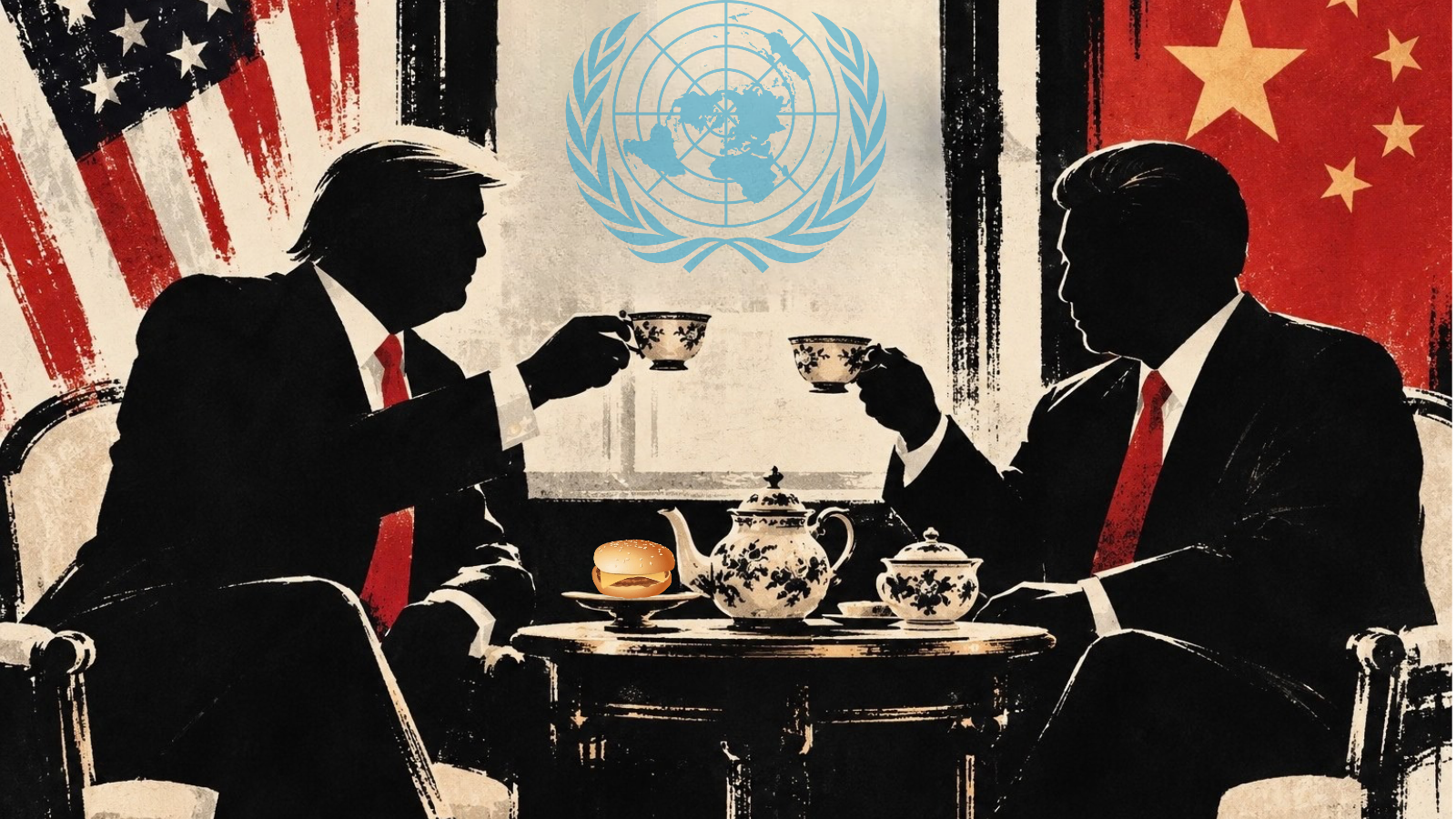
Last Tuesday, before the speeches really got underway at the United Nations, I gave you my list. Would anyone from the United States talk to the Iranians? What would happen when Trump left New York and sat down with Xi Jinping? And what would the United States do at the UN’s meeting on preparing for the next pandemic?
By the end of the week, we had answers. Sort of.
American envoys spent three hours meeting with Iranian mediators,
The United States opposed the pandemic declaration,
And Trump hosted Xi for a state visit filled with military honors, a state dinner, Marine One, tea, and a tour of the National Archives.
After all of it, the question I’m left with isn’t whether Trump had meetings. It’s this: What did America get from them?
Iran: threats outside, talks inside
Iran was the headline. Trump told the General Assembly that he believed a deal could happen after the midterms because Tehran was “waiting to see how I do in the midterm election.” Then came the alternative. Annihilation.
Trump talked about the choice between making a deal with Iran and destroying the Islamic Republic. I would say this is completely out of place, but the entire room has come to expect this talk from the current leader of the United States. Yet, while Trump was publicly threatening Iran, something very different was happening behind the scenes.
Steve Witkoff and Jared Kushner (as expected, he made an appearance…) spent three hours meeting with Iranian mediators on the sidelines of UNGA. Trump called the meeting "very good" and "very productive" and said another would be scheduled in the “very near future.” Iranian state media went further, reporting that Foreign Minister Abbas Araghchi conveyed Iran’s conditions for reopening the Strait of Hormuz: lift the U.S. naval blockade, unfreeze Iranian assets, and end the war on all fronts.
Those aren’t pleasantries. They’re negotiating positions. I’m glad they were talking. Again. But that reference to the midterms jumped out at me. I spent years reading threat briefings. Adversaries listen for timelines. They look for pressure points. They pay very close attention when an American president tells them publicly what he thinks changes after an election.
This morning, Iran’s Revolutionary Guard delivered a message directly to the American public ahead of the midterms, urging Americans to take to the streets against Trump’s policies and arguing that his war in the Middle East has failed. Remember what Trump said at the UN: Iran is "waiting to see how I do in the midterm election." Well, Iran certainly appears to be paying attention.
So my question isn’t whether diplomacy happened. It did. My question is what happens now. Because days later, Trump was sitting across from the leader of Iran’s largest trading partner, and one of the countries with the most economic leverage over Tehran—Xi Jinping.
So what did Xi bring to Washington?
There were actual outcomes from the Xi visit, and they shouldn’t be ignored. The United States and China extended their broader trade truce for two months. Over the weekend, the two governments released reciprocal lists covering roughly $30 billion in trade in each direction that they are recommending for reduced tariff treatment. The two sides also announced progress on fentanyl precursors and military crisis communications.
Those things matter. But given what had just happened at the UN, I was watching for something else. Iran.
Trump had just threatened Iran with annihilation. His envoys had spent three hours meeting with Iranian mediators, and now he was sitting across from the leader of Iran’s largest trading partner. China urged Washington and Tehran to return to negotiations. But despite Beijing’s enormous economic leverage over Tehran, there was no major public Chinese commitment to pressure Iran. So what did Trump ask Xi to do? Did he press China over its purchases of Iranian oil? Did Beijing make any commitment to increase pressure on Tehran? Was there a concrete ask? We heard the tough talk at the UNGA podium. I’d like to know how much of it made it into the room with Xi.
Iran wasn’t the only unresolved question.
There’s Taiwan
The Trump administration is currently withholding a roughly $14 billion weapons package for Taiwan—one that State Department officials put together and congressional leaders approved earlier this year. Trump has actually described holding back arms sales to Taiwan as a “very good negotiating chip” with China. According to the U.S. Ambassador to China David Perdue, Taiwan arms sales come up whenever Trump and Xi meet. On Fox News Sunday, Perdue was asked about concerns over the withheld Taiwan package. He defended Trump’s record on Taiwan and said there were continuing discussions about additional sales.
Then he revealed something extraordinary. Perdue said Trump had asked Xi whether China would like to buy American weapons too. Yes. China.
By Monday, the State Department was saying that U.S. law prohibits arms sales to China and that there was “no offer or plan to sell arms to China.” Trump denied the conversation happened. There was his go-to phrase—the verbal equivalent of “I don’t know him.” “I never heard of that one,” Trump said. “We didn’t discuss it.”
Except this wasn’t some random person he was being asked about. It was his own ambassador to China describing what he says Trump said to Xi Jinping. But as always, he can’t help himself and says the quiet part out loud. When asked whether he would consider selling weapons to China, Trump added: “Maybe it’s a good idea.” Meanwhile, Taiwan says U.S. arms sales to the island remain unchanged, but that roughly $14 billion package is still on hold.
And this is where the whole thing becomes a national security question for me. The United States spends billions preparing for the possibility of conflict with China. Sensitive technologies are restricted from reaching Beijing. American alliances across the Indo-Pacific are built in large part around deterring Chinese aggression, and U.S. law commits us to helping Taiwan maintain a sufficient self-defense capability. So when the U.S. ambassador to China says the President of the United States asked Xi Jinping whether China wanted to buy American weapons, and Trump responds that maybe selling them weapons is “a good idea,” we should all have questions.
I don’t care where you land politically. What exactly is our national security strategy toward China? Because you can’t spend years warning Americans about the military challenge posed by Beijing while treating American weapons as just another potential deal on the table. At some point, national security has to be more than a talking point. It has to govern the decisions you make.
Which brings me to the F-35 fiasco. As I wrote in my last Covfefe article, the Pentagon is investigating how F-35 components ended up in Hong Kong. Days later, how they got there remains unexplained. With Xi in Washington, it seems like something worth bringing up over tea…
And then there was the pandemic meeting
On Friday, the United Nations held a high-level meeting on pandemic preparedness. Six years after COVID killed millions of people around the world, shut down schools and businesses, overwhelmed hospitals, disrupted supply chains, and upended basically every part of our lives, the countries of the world gathered to talk about how not to do that again. The UN itself described the meeting as an effort to address the weaknesses exposed by COVID and strengthen surveillance, laboratories, health systems, and access to medical products.
The United States opposed the proposed political declaration. This wasn’t a treaty handing control of American public health to the UN. It was a political declaration focused on preparing countries for future pandemics. Now, to be fair, other countries had concerns with the text too. But some of the objections the United States raised stopped me in my tracks.
The Trump administration objected to what it characterized as "divisive ideologies" in the document, and raised objections involving the international framework for pathogen sharing. Reporting also indicated that the administration was unhappy with references to equity and universal access to sexual and reproductive health services. Read that again. We are talking about preparing for pandemics, people!
I sat on the White House COVID Task Force. I remember early 2020. We needed the sample, the sequence, and reliable data. And we needed them yesterday. We were making enormous decisions while staring through a fog, trying to understand what was spreading, how it was spreading, who was most vulnerable, and what we weren’t being told. Every single day mattered.
So debate the details. Demand accountability. Negotiate better language if the language isn’t right. But after everything this country lived through during COVID, the idea that arguments over "divisive ideologies" and reproductive-health language are part of a dispute over how the world prepares for the next pandemic is difficult for me to comprehend. Viruses don’t care about our culture wars. They don’t care which administration is in office. They don’t care how we voted. And they certainly don’t wait for us to finish arguing before they spread. We learned that already.
So, what did we get?
There were real diplomatic outcomes last week. American envoys spent three hours with Iranian mediators. The United States and China made progress on trade. Those things matter, and I’m not going to pretend they didn’t happen because it would make for a cleaner argument. But after all the speeches, meetings, and ceremony, some of the biggest questions are still unanswered.
Last week I told you that I care less about what happens at the podium than what happens around it. I’ve been on the inside of these foreign policy weeks. I know how much work goes into every meeting and every ask. Now we have the readout. Some of it was substantive, and a lot of it was spectacle. But foreign policy isn’t the speech. It isn’t the motorcade. And it definitely isn’t tea. It’s what you got when the meeting was over.
On some of the biggest national security questions of the week, we’re still waiting for that answer.
Or maybe that’s the answer right there.
–Olivia
Truth, Olivia.
All Americans raise. 🌎🇺🇸💕🤞🏼
I fear that is, indeed, the answer.