


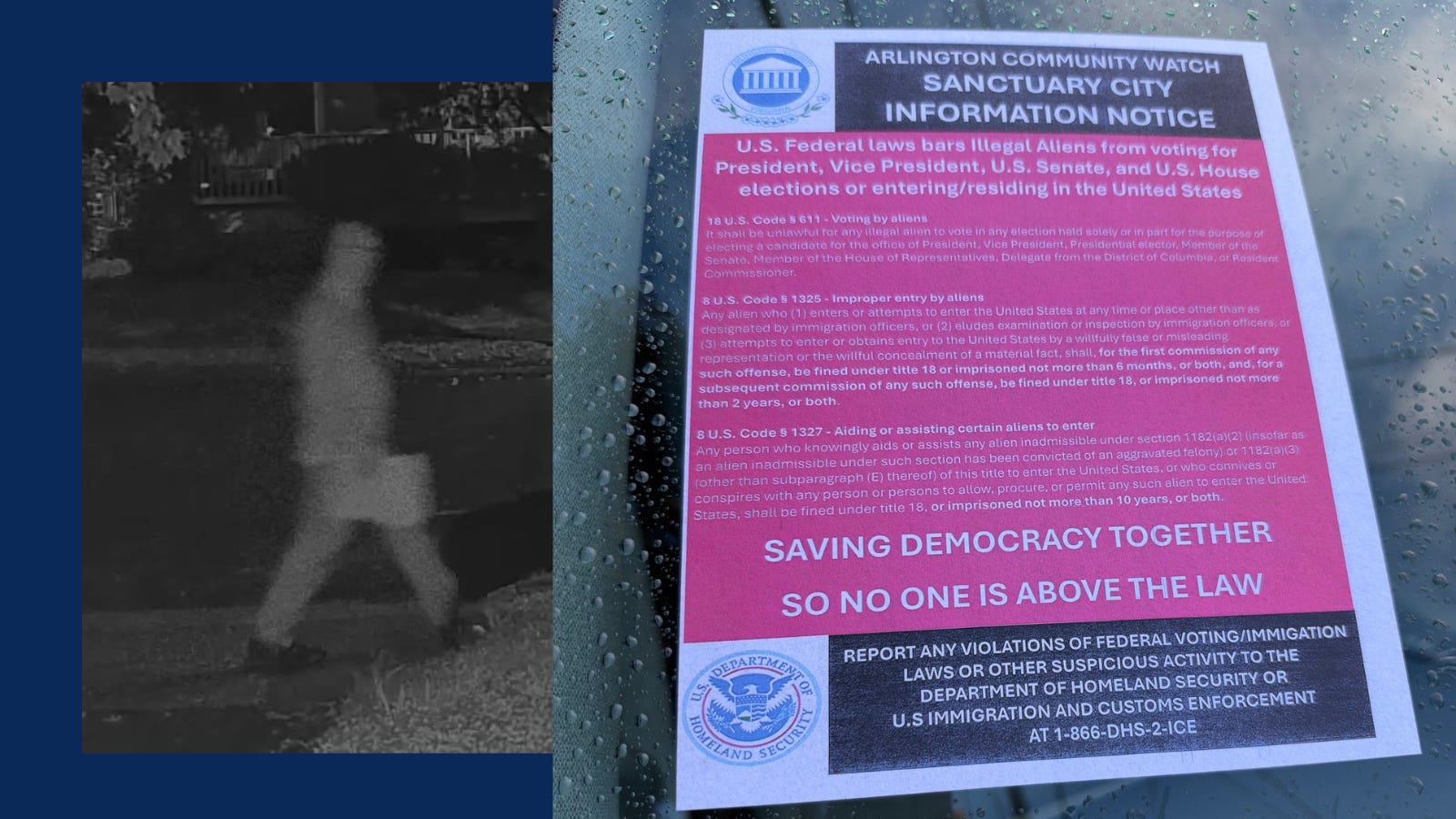
Last Monday, at my home in Northern Virginia, I woke up, looked outside, and saw paper tucked under the windshield wipers of every car on my block. And the next block. And the one after that.
They were flyers. “Sanctuary City Information Notice.” A Department of Homeland Security seal in the corner. A list of federal laws about “illegal aliens” voting. A hotline for neighbors to report anyone they suspected. It was the actual ICE tip line.
My security cameras caught the person who did it. Middle of the night. Masked up. Fully covered, walking car to car with a stack of these things like he was delivering pizza menus. I’ve lived in this area on and off for twenty years, between career assignments and deployments. I’ve never seen anything like it.
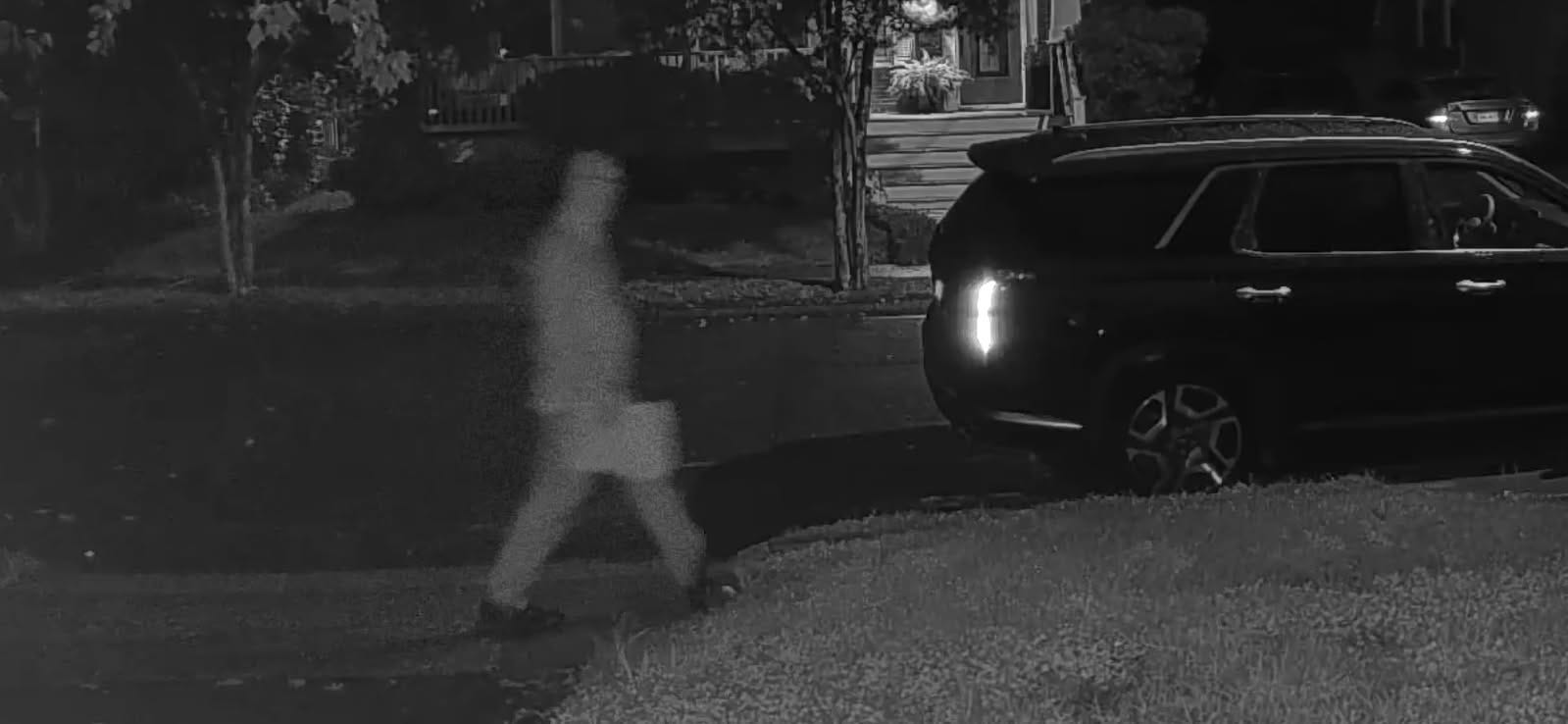
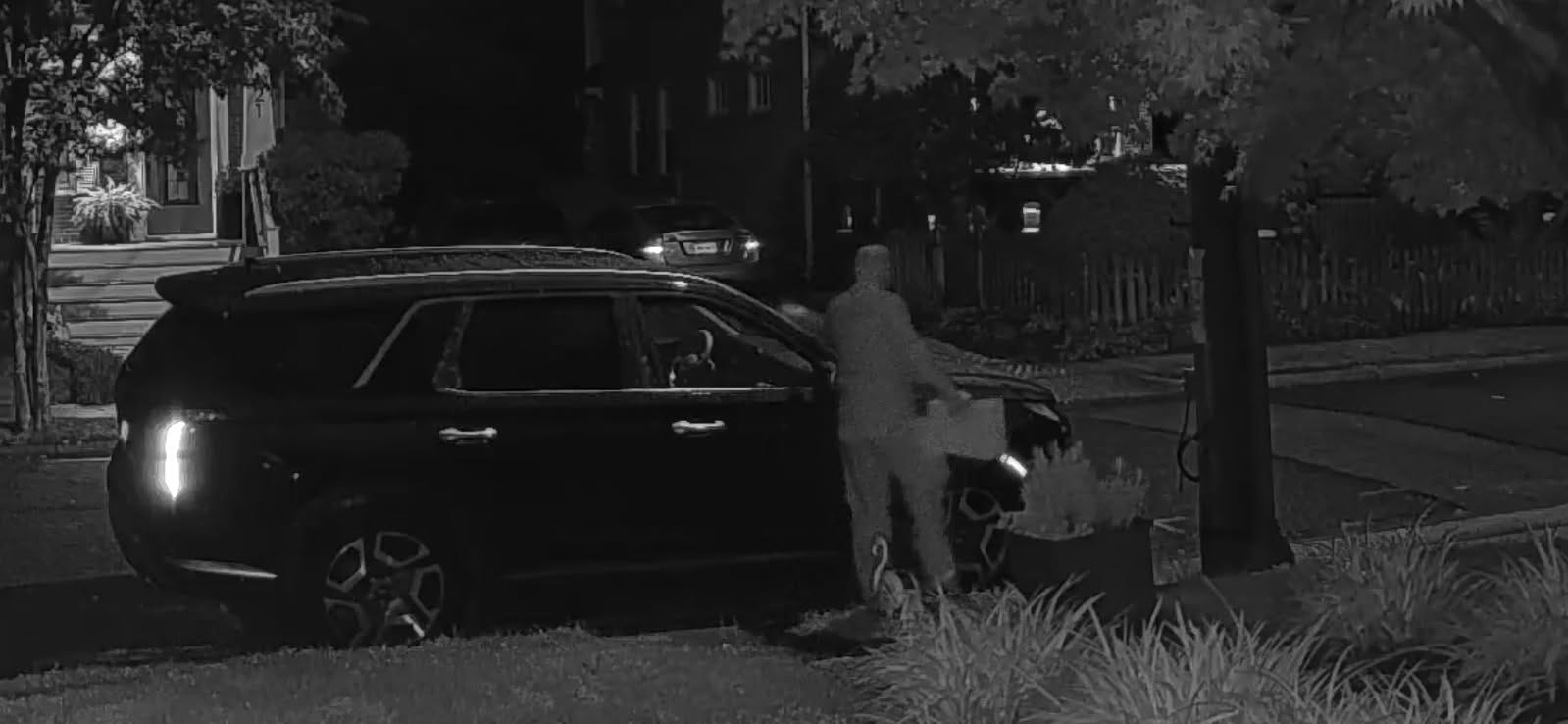
My mom was here that morning. Before I could stop her, she walked outside and read the flyer in my hand. She’s a Mexican immigrant and a U.S. citizen, and she was scared. That’s the part I can’t shake. Not the paper. The fact that a woman who has done everything right in this country, who raised a daughter who spent more than twenty years protecting it, read that flyer and felt hunted.
That was the point.
I contacted the mayor, gave my security footage to Alexandria police, and made sure local media knew what happened.
Authority borrowed, real fear
DHS says it had nothing to do with the flyers. Okay. So someone put a federal agency’s seal on a piece of propaganda and distributed it through neighborhoods weeks before an election, with early voting already underway in Virginia.
And there wasn’t just one version. In Del Ray, the flyers said: “Arlington Community Watch” (wrong county, but whatever). Another version read “Volunteer Community Watch.” Same design. Same federal seal. Same ICE hotline. Different labels.
That’s not a typo. Someone went to the trouble of making different versions of the same warning.
Who made them? And how many more are out there?
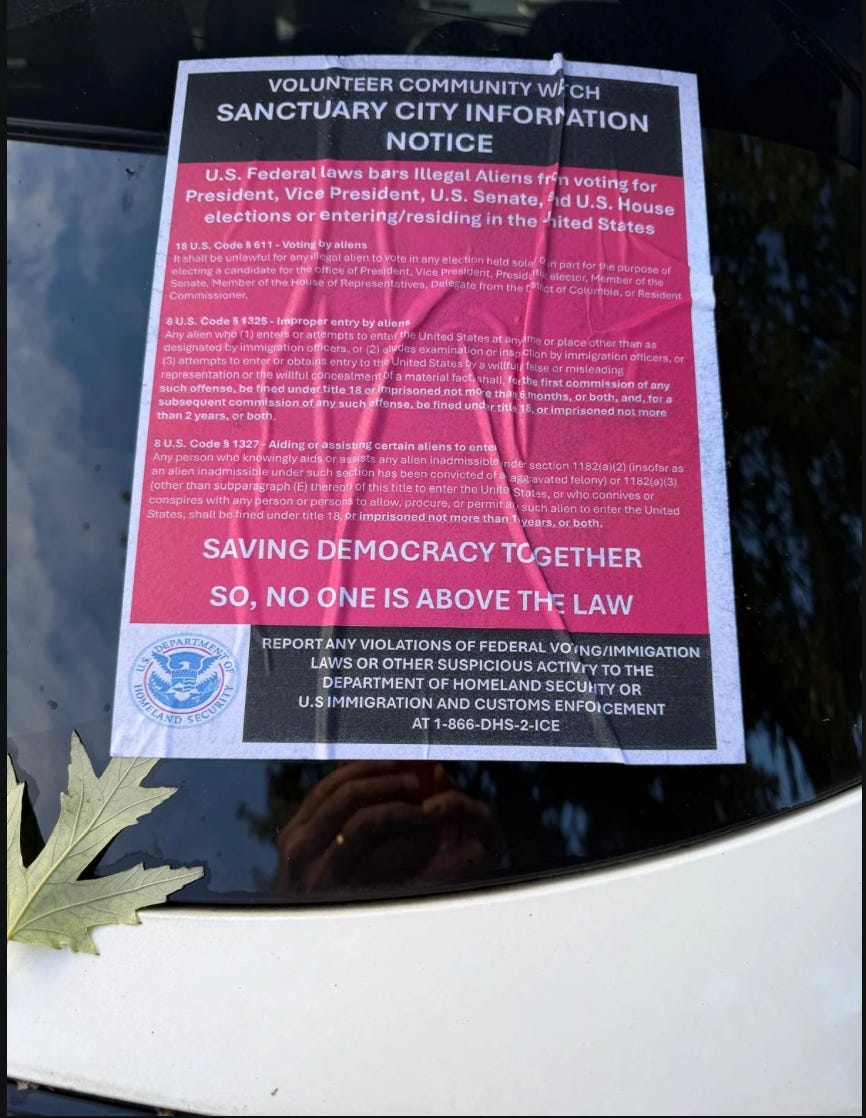
The flyers call us a sanctuary city. Neither Alexandria nor Arlington officially uses that designation. But facts were never the point.
Here’s the trick: the flyers mostly recite actual law. Non-citizens cannot vote in federal elections. True!
So, who’s the audience?
Naturalized citizens have every right to vote. Green card holders cannot vote in federal elections. But neither should have to fear being reported to DHS because of their accent, last name, or skin color. And the flyer isn’t really talking to them. It’s talking to the guy next door, handing him a hotline and a permission slip to turn suspicion into a call to DHS.
That’s not a community watch. That’s a snitch line with a federal seal slapped on it.
Police say they’re still investigating. Nobody knows who distributed these flyers. And I want to know who did.
It’s not just my street
I started looking for identical flyers elsewhere. I haven’t found them. Yet.
Instead, I found a troubling pattern: different tactics, different states, and recurring messages about who belongs at the ballot box.
Miami: Earlier this month, a man allegedly impersonated an ICE agent at a Miami Dade College voting site where Brazilians were casting ballots in their country’s election. Wearing an ICE jacket, hat, and mask, he reportedly frightened voters who feared deportation. He told investigators he wanted to “see people’s reactions.” He’s charged with voter intimidation.
He didn’t need a U.S. election to frighten people. Just the costume.
North Carolina: About 1,400 registered voters received letters questioning their citizenship and asking them to prove eligibility or remove themselves from the rolls. They were flagged by the federal SAVE database, which can misidentify recently naturalized citizens. Eligible voters were not automatically removed from the rolls.
But imagine opening a letter questioning whether you’re American.
Syracuse, New York: ICE agents entered an active polling place in June to confront a poll worker about an Instagram post. Even the county’s Republican election commissioner criticized the signal it sent.
And this isn’t new.
North Carolina, 2024: A group placed nearly 1,000 Spanish-language warning signs near early voting sites. The signs accurately stated that noncitizens couldn’t vote, and election officials allowed them to remain. Here’s the rub: the group’s president was recorded describing voters with “Hispanic-sounding last names” as suspicious…
These incidents don’t prove a single coordinated operation, but they do show how different tactics can produce the same result: fear around voting.
NOTE: If you’ve seen flyers like the ones in my neighborhood, send me a photo, the city, date, and location. You’re my national search party. And please, let your local law enforcement and authorities know.
I write these Deep Dives to connect what’s happening in our neighborhoods to the decisions being made in Washington, and to uncover the stories that deserve more attention. If this reporting matters to you, consider becoming a paid subscriber. Your support keeps this work going.
Follow the numbers
Now look at what the federal government is telling Americans.
In July, DHS Secretary Markwayne Mullin claimed the department had identified more than 250,000 potential noncitizens registered to vote in four states. A staggering number. Except FactCheck.org’s July 17 analysis found that DHS hadn’t disclosed its methodology. Election experts warned that comparing voter rolls with commercial databases can produce false matches.
Your name appears in two databases, and suddenly you’re being counted as a suspected noncitizen. What?!
In Nevada, DHS initially flagged nearly 16,000 records. After further review, that fell to 185. Nevada officials later reported that all 185 were U.S. citizens. By the time the numbers were corrected, the scary headline had already traveled.
I warned about all of this on September 1 in my article ICE Is Coming for the Voter Rolls, when Homeland Security Investigations–an agency that investigates terrorism, cartels, and serious transnational crimes–was being directed toward voter rolls in nine states.
Prosecute actual violations. Absolutely. But let’s not confuse allegations, questionable records, and proven illegal votes. They aren’t interchangeable.
Then came Monday’s arrests in California.
DOJ announced 28 arrests under "Operation Protect the Vote." Those arrested were lawful permanent residents—green card holders—not undocumented immigrants. One was a 72-year-old Belize-born man taken from his home in pajamas by heavily armed agents.
If proven, the alleged violations warrant appropriate consequences. But fifteen days before Election Day, images of armed agents arresting immigrants send a message far beyond those charged.
Meanwhile, FBI Director Kash Patel celebrated Monday’s California arrests involving alleged voter fraud.


Twenty-eight arrests. A national announcement. Another headline about voter fraud. Reminder that arrests aren’t convictions, and individual allegations don’t prove widespread illegal voting.
When government becomes the messenger
Since September 2025, DOJ has sued 30 states and Washington, D.C., demanding unredacted voter rolls containing sensitive information about millions of Americans. Utah’s Republican Lieutenant Governor Deidre Henderson refused to surrender protected information. Other states have pushed back, too.
Here’s what happened in court.
Federal judges dismissed all 26 cases that had received final district-court rulings. Twelve judges were Republican appointees, including eight appointed by Trump. A George W. Bush-appointed judge in West Virginia called DOJ’s demand "devoid of any factual basis." Other judges found that the laws DOJ cited didn’t authorize its demands.
The administration has appealed most rulings. Yet the nationwide push for voter data continues. California offers a glimpse of what that pressure looks like on the ground. DOJ gave officials 48 hours to review a list of 20,000 supposed noncitizens, then sued.
Federal officials also warned that election workers counting unlawful ballots could face criminal liability. Trump went further, posting that people involved "will all go to jail for a long period of time!!!"
Imagine being a county election worker reading that.
On 60 Minutes, Lesley Stahl asked DOJ civil rights chief Harmeet Dhillon whether these efforts were intended to sow distrust in elections.
Her answer: No. "The distrust is there."
Asked about the election process, Dhillon also said she expected normal counting and certification, "absent some shocking contingency."
But distrust doesn’t appear out of nowhere.
I’ve spent more than twenty years working in national security. I’ve sat through briefings on foreign influence operations designed to undermine trust in American institutions. Official-looking material. Anonymous distribution. A targeted audience. A frightening narrative that doesn’t need to be true to do damage.
I’ve also worked inside the Trump White House alongside Trump and Stephen Miller, with Kash Patel in that orbit. I watched political fear become a messaging strategy. In the lead-up to the 2020 election, it was “law and order.” I remember a meeting where they described the audience they wanted to reach and scare as “suburban housewives.”
Immigration was part of that messaging, too. By the 2024 election, it had become an even more prominent campaign issue.
Now it’s noncitizen voting. Different crisis. Different target. Familiar tactics.
And that’s what I recognized when I saw those flyers on my neighbors’ windshields. I cannot tell you who printed them. I won’t pretend they’re connected to anyone in government. However, when national leaders repeatedly warn of an invasion of illegal voters, someone distributing anonymous warnings in a neighborhood doesn’t have to invent the narrative. It’s already out there.
What happens after Election Day?
Trump has called for Republicans to “nationalize the voting” in roughly fifteen places. At last month’s Republican Midterm Convention, he led supporters in a pledge to vote, even if they weren’t registered, and to "cheat like hell."
On Monday, ProPublica reported that DHS political appointees asked CISA—the agency responsible for helping protect election infrastructure—to secretly obtain and hack a voting machine, report findings to the White House, and conceal vulnerabilities from the manufacturer. Career officials refused. The plan reportedly never happened.
If you discover an election-system vulnerability, the responsible thing is to fix it, but why keep it secret? One former official suggested the information could be used to cast doubt on election results.
Before Election Day, fear can discourage eligible citizens from voting. After Election Day, fraud allegations can become ammunition to challenge results.
Two different consequences. One common casualty: public trust in elections.
So what do we do?
Fear is what they’re counting on. Don’t give it the final word.
Found a flyer, sign, or strange letter? Don’t toss it. Photograph it where you found it and note the time and place. Report suspected voter intimidation to election officials or law enforcement. You can also call 866-OUR-VOTE (866-687-8683) or 888-VE-Y-VOTA for assistance in Spanish.
Call your people. Especially naturalized citizens and mixed-status families. Eligible, registered citizens have every right to vote. Period.
Show up. Sign up to serve as a poll worker or learn how to become an authorized election observer.
Don’t spread panic. Verify alarming claims about polling places with election officials before sharing them. Rumors can do the intimidators’ work for them.
Vote. Early, if you can. Know your rights, make a plan, and don’t let intimidation make that decision for you.
They left their message on my car. Here’s mine back: my neighbors, my mom, and millions of people like her aren’t going anywhere. We’re voting.
Until next time,
–Olivia
Olivia - evil people who are afraid of losing power. Make a plan, bring a friend, get out and express your right to vote. I voted last Saturday on day 1 in Nevada, North Las Vegas. Friendly election workers, no harassing.
Olivia, you were all over WTOP radio last week with this story. Thanks for all that you do, including marching with us across Memorial Bridge on Saturday!